Ir directamente al contenido


A dog is pregnant for about 63 days from ovulation — roughly nine weeks — and almost nothing is visible for the first three of them. That gap between conception and any outward sign is why the early weeks feel so uncertain, and why a calendar is more useful than watching her for changes that are not going to appear yet.
This is a week-by-week guide to what is happening inside, what she needs from you at each stage, and the points where you should stop reading and ring your vet. If you are still working out how long a dog's pregnancy actually lasts, or you have not had it confirmed and are going on suspicion, both of those are worth settling first.
Two things before the weeks.
Your vet leads this, not a blog. Confirmation, diet, worming, exercise and anything that goes wrong all belong with the person who can examine her. If at any point she is straining without producing a puppy, has a discharge that smells or is discoloured, goes off food entirely, seems distressed, or passes her due date — that is a call today, not tomorrow.
And more is not better. Over-supplementing a pregnant bitch causes real harm, and calcium is the example worth knowing because it works the opposite way round to intuition. The MSD Veterinary Manual states plainly that oral calcium supplementation during gestation “is not indicated and may cause rather than prevent postpartum hypocalcemia”. Feeding extra calcium while she is pregnant turns down the system that mobilises her own stores, so she copes less well when lactation demand peaks two to three weeks after whelping — the point at which eclampsia typically appears, most often in small-breed bitches feeding large litters. Vitamin A is a maximum rather than a target in the same way: FEDIAF, whose nutritional guidelines are what most UK pet foods are formulated against, sets a nutritional maximum for vitamin A and does not relax it for pregnancy. One product at the stated amount, agreed with your vet, beats three stacked on top of each other — particularly if several contain the same nutrients.
The nine weeks at a glance
- Week 1 (days 0–7): fertilisation; no visible changes.
- Week 2 (days 8–14): embryos implant; mild appetite shifts.
- Week 3 (days 15–21): hormonal changes; possible queasiness.
- Week 4 (days 22–28): your vet may confirm; nipples slightly enlarge.
- Week 5 (days 29–35): puppies' organs form; calorie needs begin to rise.
- Week 6 (days 36–42): abdomen rounds; appetite increases.
- Week 7 (days 43–49): coat and nails develop; nesting may start.
- Week 8 (days 50–56): visible puppy movement; colostrum may appear.
- Week 9 (days 57–63): whelping preparation; temperature drop before labour.
Those dates run from ovulation rather than from mating, which is part of why due dates are approximate. Your vet's estimate beats the calendar.
Week by week

Week 1 (days 0–7): the quiet beginning
What you'll notice: usually nothing at all. Keep life calm and consistent.
- Stick to her normal complete diet. No need to increase calories yet, and doing so early tends to put on condition she does not need.
- Gentle exercise only — this is not the moment to start a new activity.
- If you are considering a supplement, this is the point to raise it with your vet rather than to start one.
Week 2 (days 8–14): implantation and hormone shift
Signs: slight appetite change, mild tiredness. Both easy to miss.
- Keep stress low and water available.
- Start weighing her weekly. Gradual gain is what you want, and a baseline now is worth having later.
- Still maintenance calories. Quality of food matters more than quantity at this stage.
Week 3 (days 15–21): the first real symptoms
Signs: mild queasiness, sometimes called morning sickness, and occasional picky eating. It usually passes.
- Offer smaller, more frequent meals if her appetite dips.
- Avoid unnecessary medications, and do not use flea or worm treatments without checking they are safe in pregnancy. This one catches people out — a routine treatment you have given for years may not be appropriate now.
Week 4 (days 22–28): time to confirm

Signs: nipples may enlarge and pinken; the abdomen is still subtle.
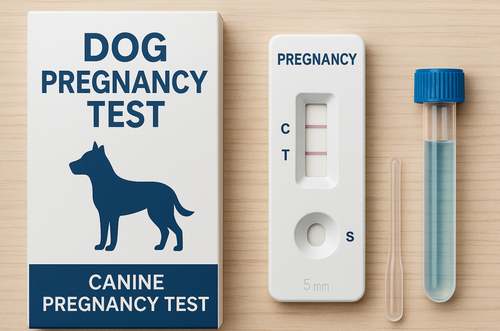
This is the common window for confirmation, and your vet will advise on ultrasound timing. If you have not already looked at confirming the pregnancy in the first place, now is when guessing stops being good enough — a false pregnancy can look very similar for several weeks.
- Begin planning the whelping area: quiet, warm, easily cleaned.
- Keep exercise light to moderate.
- Start the gradual transition towards a higher-energy food, over several days rather than overnight.
- If your vet has agreed a supplement, Calmdogs® Prenatal Chews are one option among several.
Week 5 (days 29–35): the growth spurt
Signs: her shape starts to change and hunger increases. This is where it becomes real to most owners.
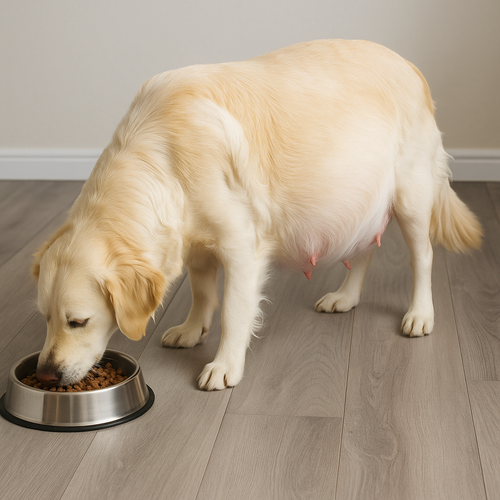
- Split her daily food into three or four smaller meals. There is less room in there than there was.
- Calm routines; no rough play.
- Calorie needs genuinely rise now, and protein quality matters. Increase gradually and under guidance rather than free-feeding.
- Iron, folic acid and zinc are the nutrients most often discussed at this stage, and are among those in Calmdogs® Prenatal Chews.
Week 6 (days 36–42): clearly pregnant

Signs: rounding abdomen, weight gain clearly visible.
- Keep her clean and brushed; check nipples and skin gently.
- Short, frequent walks suit her better now than one long one.
- Continue increasing calories gradually, under vet guidance.
- DHA comes up a lot at this stage. It is a structural component of brain and retinal tissue, which is why it appears in prenatal formulations — whether she needs more of it is a question for your vet. If you are already using a prenatal chew, check what it already contains before adding anything else.
Week 7 (days 43–49): nesting and the final stretch

Signs: nesting behaviour, restlessness, more naps.
- Finalise the whelping box: warm, draught-free, clean bedding.
- Trim the hair around her nipples if she is long-coated, for nursing hygiene.
- High-quality food, frequent smaller meals.
- Calcium from a complete diet is the norm. Do not add high-dose standalone calcium unless your vet has specifically directed it — for the reason set out at the top of this page.
Week 8 (days 50–56): almost there

Signs: you may see or feel the puppies moving; mammary glands fuller; colostrum possible.
- Temperature charting can start. A drop to around 37.2 °C often precedes labour by roughly 24 hours, and charting twice daily for a few days first gives you her normal to compare against.
- Keep toileting areas accessible and avoid travel.
- Energy needs peak around now.
- Whatever routine you and your vet settled on, keep it consistent rather than changing things this late.
Week 9 (days 57–63): whelping preparation
Signs: restlessness, scratching, hiding, the temperature drop, and often a reduced appetite in the final day or two.
- Prepare the kit: your vet's out-of-hours number written down somewhere you will find it at 3am, clean towels, a puppy scale, a heat source as advised, and gloves.
- Keep the house calm and supervise closely.
- What she needs nutritionally after whelping is a separate conversation, and one to have with your vet rather than to plan from a guide.
Ring the vet without waiting if: she strains hard for 20–30 minutes with no puppy, more than two hours pass between puppies while she is still clearly in labour, there is a foul or dark discharge, she is trembling or collapsed, or the due date passes with no signs at all.
Where a prenatal supplement fits, honestly
Pregnancy raises demand for certain nutrients. That is not in dispute. What is less often said is that a bitch on a complete, good-quality diet appropriate to her life stage is frequently already covered, and plenty of vets will simply move her onto a growth formulation rather than add anything.
So treat a supplement as something to discuss, not something to assume. If you do use one, these are the nutrients that come up and what can honestly be said about them:
- Folic acid — supports normal foetal neural development.
- Iron — supports normal red blood cell production.
- Zinc — involved in normal cell division, and in skin and coat condition.
- B vitamins — involved in normal energy metabolism.
- DHA — a structural component of brain and retinal tissue.
You will notice none of those say prevents, ensures or protects. A complementary feed is food, and food supports normal function; it does not prevent disease or guarantee outcomes. Anything marketed to you in those terms during a pregnancy is worth treating with suspicion, and it is worth knowing how to read a supplement label properly before you buy anything at all.
We make one — Calmdogs® Prenatal Chews, a complementary feed for breeding bitches containing iron, zinc and folic acid. If you want the criteria rather than the sales pitch, we have written separately about choosing a prenatal supplement, including where our own falls short.
Calmdogs® Prenatal Chews are a complementary feed, not a veterinary medicine. They do not diagnose, treat, cure or prevent any disease or condition. Supplements complement a vet-approved diet rather than replacing it. Always seek veterinary advice before starting any supplement, particularly if your dog has an underlying condition or is on medication.
Exercise, grooming and hygiene
- Exercise: daily gentle walks keep her mobile and settled. Avoid high impact and avoid overheating, which matters more than people expect in the last fortnight.
- Grooming: regular brushing, check nipples and abdomen, keep bedding clean and dry.
- Parasite control: only with products your vet has confirmed are safe during pregnancy.
Last bark
Nine weeks, and for the first three of them there is very little to see. Weigh her weekly, feed her properly rather than heavily, get the pregnancy confirmed rather than assumed, and keep your vet's number where you can find it in the middle of the night.
Everything else — including whether she needs a supplement at all — follows from that conversation rather than from this page.
Frequently Asked Questions
Here are some common questions customers may have about this topic.
How long is a dog pregnant, and when will I see anything?
About 63 days from ovulation, which is roughly nine weeks. Very little is visible for the first three weeks. Early signs are subtle and easy to miss, such as slight appetite changes, mild tiredness or occasional queasiness. Because the dates run from ovulation rather than mating, due dates are approximate and your vet's estimate is more reliable than a calendar.
When can my vet confirm the pregnancy?
Weeks 4 to 5, roughly days 22 to 35, is the common window, and your vet will advise on ultrasound timing. Around then you may notice the nipples enlarging or pinkening. Confirming matters because a false pregnancy can look very similar from the outside for several weeks.
How should I change her diet as the weeks go on?
Keep her on her normal complete diet for the first few weeks without increasing calories. From around week 4 begin a gradual transition towards a higher-energy food over several days. From week 5 her calorie and protein needs rise, and three or four smaller meals a day suit her better than one or two as space becomes limited.
Does a pregnant dog need supplements?
Not automatically. A bitch on a complete, good-quality diet is frequently already covered, and many vets will simply move her onto a growth formulation rather than add anything. Where a supplement is used, the nutrients usually discussed are folic acid, iron, zinc and B vitamins. Decide with your vet rather than by default, and avoid stacking products that contain the same nutrients, because over-supplementation causes real harm.
When should I call the vet during a dog's pregnancy?
Call without waiting if she strains hard for 20 to 30 minutes without producing a puppy, if more than two hours pass between puppies while she is still clearly in labour, if there is a foul or discoloured discharge, if she is trembling or collapsed, or if the due date passes with no signs at all. Also call if she goes off food entirely or seems distressed at any stage.