
If your bitch is pregnant, the useful order of operations is: talk to your vet, get her diet right, and only then think about a supplement. A prenatal chew is a complementary feed — food, not medicine — and the most important thing to understand about this category is that more is not better. Over-supplementing a pregnant dog can do real harm, particularly with vitamin A and with calcium.
That is not a disclaimer we are burying at the bottom. It is the single most useful thing on this page, and it is why this is a guide to choosing rather than a list of things to buy.
What follows is what to look for on a label, what the individual nutrients are actually there to do, and then our own chew measured against the same criteria — including the two places it does not clear the bar we set.
First: does she need one at all?
Often, no.
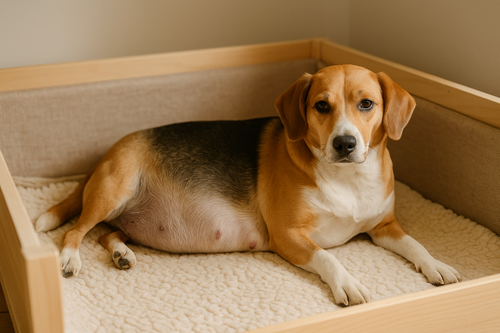
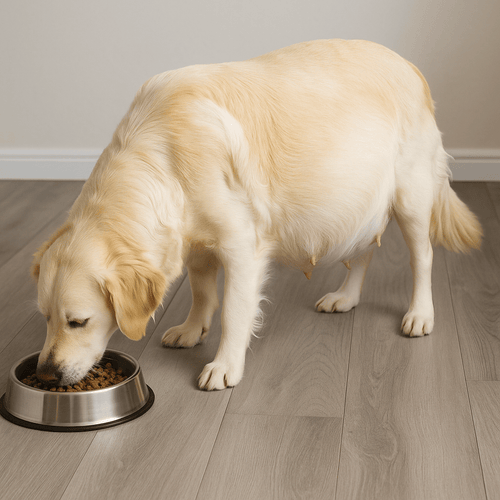
A bitch on a complete, good-quality diet appropriate to her life stage is already getting a balanced nutrient profile, and many vets will simply move her onto a growth or puppy formulation in the second half of pregnancy rather than adding anything. That is a legitimate approach and it is frequently the right one.
A supplement becomes worth discussing when there is a specific reason — a bitch in poor condition, a known shortfall, a large litter, or a vet who has suggested one. The decision belongs with the person who has examined her.
And if something is actually wrong — she is off her food, lethargic, has any discharge, is straining, or you are simply worried — that is a phone call to your vet today, not a supplement question. A bitch in trouble needs a vet. Nothing sold in a tub is a substitute for that, and this is the category where getting that order wrong costs the most.
What to look for on the label
1. Quantities, not just an ingredient list
The single most useful thing on any supplement label is a list of actives with an amount against each one, per chew. A long list of nutrient names with no numbers tells you a product contains something, not how much — and in pregnancy, how much is the entire question. This is the same discipline as reading the label on any supplement, and it applies more sharply here than anywhere else.
2. Dosing banded by body weight
A single instruction for every dog is a poor sign. A 4 kg terrier and a 40 kg mastiff are not receiving the same thing.
3. What the chew is actually made of
Look past the actives to the base and the carriers. If your bitch reacts to a particular protein, the most impressive nutrient panel in the world will not help you.
4. A clear complementary-feed statement
These are foods, not medicines, and a label that says so is being accurate. One promising to prevent birth defects, prevent deficiency, ensure a healthy litter or reduce complications is making claims a feed is not entitled to make — and in this category those claims prey on people at their most anxious.
5. Nothing that should not be there
Xylitol is toxic to dogs and has no business in any pet supplement. Check for it, along with anything else you would not recognise as food.
6. A named UK-responsible business
Someone identifiable you can contact and ask a question, and who will answer it.
The nutrients, and what can honestly be said about them
This is where most writing in the category goes wrong, so here is the careful version.
- Folic acid — supports normal foetal neural development. That is the accurate framing. It is not a claim to prevent birth defects, and any product making that claim is overstepping.
- Iron — supports normal red blood cell production, and demand rises during pregnancy.
- Zinc — involved in normal cell division and in skin and coat condition.
- Omega-3, particularly DHA — DHA is a structural component of brain and retinal tissue. That is a statement about what it is, not a promise about what it will do to a litter.
- B vitamins — involved in normal energy metabolism.
- Calcium — the one to be careful with. Give high-dose calcium before whelping only on veterinary advice.
- Vitamin A — also one to be careful with. Excess vitamin A during pregnancy is a recognised concern, which is why stacking several supplements that each contain it is a bad idea.
You will also see raspberry leaf marketed heavily for pregnant bitches, usually with claims about toning the uterus or easing whelping. We are not going to repeat those, because we cannot support them. If you want to use it, that is a conversation to have with your vet rather than with a shop.
Why "more is better" is the wrong instinct here
It is the instinct almost everyone has when something matters this much, and it is the one to resist. Fat-soluble vitamins accumulate rather than being flushed out, and two products that each look reasonable can add up to something that is not. If you are already feeding a complete growth diet, you may need very little on top of it, or nothing.
One supplement, at the stated amount, discussed with your vet. Not three.
Our chew against those criteria

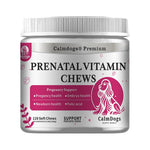
Calmdogs® Prenatal Chews are a complementary feed for breeding bitches containing iron, zinc and folic acid, in a 2.5 g soft chew, 120 to a tub, £14.95.
Dosing — passes. Banded by weight: one chew daily up to 9 kg, two daily over 9 kg. Offer with a meal; the daily amount can be split between morning and evening. Store between 15 and 30 °C.
Timing. The pack instruction is daily from mating, through pregnancy, until whelping. What happens after whelping is worth confirming with your vet rather than assuming, and it is worth asking us too — we would rather answer that than have you guess.
Quantities — partial, and we are going to be straight about it. Three actives carry a number: iron 2.5 mg, zinc 1 mg, folic acid 30 mcg per chew. The rest of the blend — vitamins E, A, D3 and B12, niacin, thiamine, pyridoxine, biotin, pantothenate, magnesium, manganese, selenium, ferrous fumarate, fish oil, nettle leaf and MSM — is listed without amounts.
By the standard set out above, that is a partial pass at best. We have just spent several hundred words telling you to look for quantities, and our own label gives you three of them. If you want the full breakdown before you buy, ask us and we will find out what the manufacturer will give us.
The base — genuinely useful, and almost nobody states it. These chews are built on cotton seed meal, not meat. There is no chicken, beef, turkey or fish protein base. For a bitch with a protein sensitivity that is a real advantage over most of the category, and it is the kind of thing you would otherwise have to email three companies to find out.
The inactives, since you will look them up anyway. Cotton seed meal, dried molasses, glycerin, polyethylene glycol, vegetable starch, sugar, vegetable oil and shortening, calcium phosphate, magnesium stearate, and TBHQ as a preservative. Two of those get raised with us regularly: there is sugar in the carrier, in the small quantity used to make a soft chew palatable, and TBHQ is a synthetic antioxidant preservative widely used in pet food and approved for it. Neither is hidden and neither is unusual in this format, but if you would rather avoid either, you now know before you order rather than after.
Complementary feed — stated. On the pack and on the page.
Calmdogs® Prenatal Chews are a complementary feed, not a veterinary medicine. They do not diagnose, treat, cure or prevent any disease or condition. Give them alongside a complete, balanced diet and on your vet's advice, and never alongside other supplements containing the same nutrients without checking first.
When a supplement is the wrong buy
She is already on a complete growth or puppy diet and doing well. Ask your vet whether anything else is needed at all. Frequently the honest answer is no, and we would rather tell you that than take the order.
You are already giving something else with overlapping nutrients. Two products both containing vitamin A is the specific situation to avoid. Stacking is where the harm in this category actually comes from.
Something is wrong right now. Off her food, lethargic, any discharge, straining without progress, or a due date that has come and gone. Vet, today. This is not the page for that.
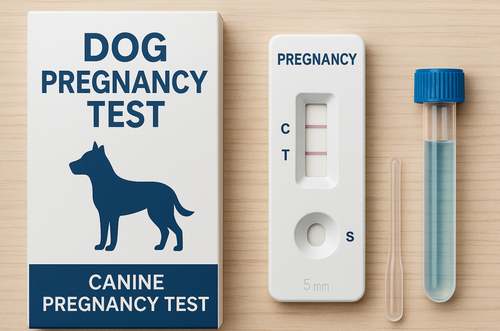
You are not certain she is pregnant. Worth confirming the pregnancy first, because a false pregnancy and a real one look similar from the outside for several weeks.
Last bark
Six things on the label, one conversation with your vet, and one supplement rather than three. If you want the wider picture, it helps to know where she is in the pregnancy before deciding what she needs.
If ours suits her, Calmdogs® Prenatal Chews are here. If your vet says she does not need anything, that is a better outcome than a sale, and it is the same honest approach we take to joint supplements.
Frequently Asked Questions
Here are some common questions customers may have about this topic.
Does my pregnant dog need a prenatal supplement?
Often not. A bitch on a complete, good-quality diet appropriate to her life stage is already receiving a balanced nutrient profile, and many vets will simply move her onto a growth or puppy formulation during the second half of pregnancy rather than adding anything. A supplement is worth discussing when there is a specific reason, such as poor condition or a vet's recommendation. The decision belongs with the person who has examined her.
Can you give a pregnant dog too many vitamins?
Yes, and this is the most important thing to understand about the category. More is not better. Fat-soluble vitamins accumulate rather than being flushed out, so two products that each look reasonable can add up to too much, and excess vitamin A during pregnancy is a recognised concern. Give one supplement at the stated amount, on veterinary advice, rather than stacking several that contain the same nutrients.
Should I give my pregnant dog calcium?
Give high-dose calcium before whelping only on veterinary advice. Calcium supplementation during pregnancy is not something to decide from a blog post or a product label, and it is a specific question to put to the vet who is looking after her.
What should I look for on a prenatal supplement label?
Six things: an amount stated against each active rather than an unquantified list of nutrient names, dosing banded by body weight, a clear statement of what the chew is actually made from, a clear complementary-feed statement, no xylitol or anything you would not recognise as food, and a named UK-responsible business you can contact. Treat claims to prevent birth defects, prevent deficiency or ensure a healthy litter as a reason to look elsewhere.
What is in Calmdogs Prenatal Chews, and how are they fed?
They are a complementary feed for breeding bitches. Three actives carry a stated amount per 2.5 g chew: iron 2.5 mg, zinc 1 mg and folic acid 30 mcg. Further vitamins and minerals, fish oil, nettle leaf and MSM are listed without amounts, which is a limitation worth knowing. The base is cotton seed meal rather than meat, so there is no chicken, beef, turkey or fish protein. Feeding is one chew daily up to 9 kg and two daily over 9 kg, offered with a meal.