
If your dog struggles with fireworks, car journeys, the vet’s waiting room or being left alone, you have probably typed “calming dog treats” or “dog anxiety chews” into a search bar and been met with a wall of near-identical packets. They all promise calm. The labels are the only thing that actually tells them apart.
This guide walks through what to look for on a calming chew label, what the ingredients are there to do, and which claims are worth ignoring. By the end you should be able to pick one up in a shop — ours or anyone else’s — and know within about thirty seconds whether it is worth your money.
First, what a calming chew actually is

In the UK, a calming chew is legally a complementary feed. It is food, not medicine. That distinction matters more than it sounds, because it tells you what a chew can honestly be expected to do: support a calmer state alongside training and management, in the way a sensible routine and a familiar blanket do. It is not a sedative, and it cannot treat a diagnosed anxiety disorder. Anything sold as a feed that says it will treat, cure or prevent anxiety is making a claim it is not entitled to make.
That is your first filter. A label making promises a food is not allowed to make is telling you something useful about the company, not about the chew.
What to look for on the label
1. Named active ingredients, with quantities
The single most useful thing on a calming chew label is a list of actives with milligram amounts per chew. Plenty of products list a “calming blend” and stop there, which tells you nothing — a blend can be 95% one cheap ingredient and a dusting of the rest. If the quantities are not on the pack or the product page, that is a fair reason to move on.
The ingredients you will see most often, and what they are traditionally used for:
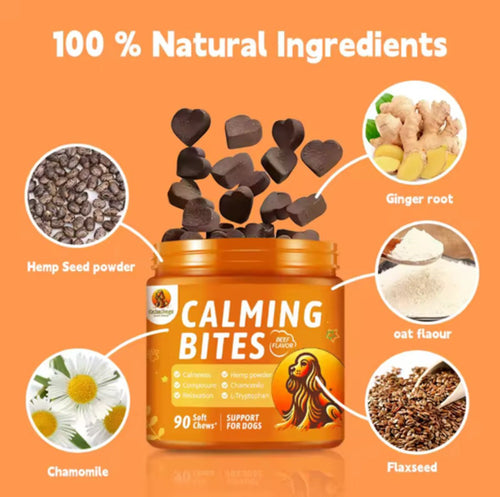
- Chamomile – a long-standing traditional botanical for supporting relaxation.
- Valerian root – also traditionally used to support calm, commonly paired with chamomile.
- Passionflower – another traditional calming botanical, often used alongside the two above.
- L-tryptophan – an amino acid that acts as a precursor to serotonin.
- L-theanine – an amino acid found in tea leaves, widely used in calming formulations.
- Ashwagandha – an adaptogenic herb used in traditional practice to support the stress response.
- Ginger root – usually included for digestive settling, which is why it turns up in travel-focused products.
- Magnesium – involved in normal nerve and muscle function.
None of these are magic and none of them work on every dog. What they should be is named, measured and appropriate.
2. A feeding guide based on your dog’s weight

A chew that says “give one or two” regardless of whether your dog is a chihuahua or a rottweiler has not been thought about very hard. Look for banded feeding by body weight, like the guide above, and check the maths before you buy: a tub of 90 chews sounds generous until you realise a large dog needs three a day.
3. Honest, hedged language
Wording like “can support”, “many owners find” and “individual dogs respond differently” is not a company being wishy-washy. It is a company describing a complementary feed accurately. The things worth treating with real suspicion are:
- Any suggestion of formal clinical evidence. On a complementary feed, that evidence is almost never actually on file, and a company that has it will normally tell you where to read it.
- Implied veterinary endorsement with nobody named. If a product leans on the authority of the profession without a real, identifiable professional attached to it, treat the endorsement as decoration.
- A precise onset time. Telling you exactly how many minutes it takes to work is a specific claim, and specific claims need specific evidence.
- Sweeping numbers about happy customers sitting alongside a handful of actual reviews.
4. What is not in it
Check the carrier and binder ingredients, not just the actives. Artificial colours and unnecessary fillers add nothing. If your dog has a known sensitivity, check the protein base — chews are commonly chicken, turkey, beef or fish flavoured, and a chicken-sensitive dog will not thank you for a chicken chew.
5. Whether it is a UK-compliant complementary feed
A UK-market product should state that it is a complementary pet food, carry a feeding guide, and name the manufacturer or distributor. Products imported from other markets sometimes contain ingredients that are not permitted for sale in pet feed here. If a listing is vague about where the product is made and who is responsible for it, that is a reasonable reason to look elsewhere.
What to realistically expect

Owners tend to arrive at calming chews hoping for an off switch, and that is not what they are. Some dogs settle noticeably; some show a modest difference you only notice in hindsight; some show nothing at all. Individual dogs respond differently, and that is genuinely how it is.
What tends to separate the owners who get somewhere from the owners who don’t is that they change more than one thing at once:
- Timing. Feed ahead of the trigger rather than in the middle of it — before the car journey, before the fireworks start, not once your dog is already pacing.
- Consistency. A single chew on the worst night of the year is the least likely scenario to show you anything.
- Training and management alongside. Desensitisation, a secure space and a predictable routine do the structural work. A chew supports that; it does not replace it. If you are starting from scratch, building a genuinely calm crate routine is worth more than any supplement, and one-to-one training is the fastest route for a dog with a specific trigger.
- Knowing when it is beyond a feed. Panic, self-injury, destruction when left alone or a dog who cannot settle at all are veterinary and behavioural questions, not shopping questions.
How our own chew measures up against that list

It would be odd to write a buying guide and then be coy about our own product, so: Calmdogs® Dog Calming Treats are a complementary feed in a 2.5 g turkey-flavoured soft chew. Here is the full active list, per chew, so you can hold it against the criteria above:
- Organic Chamomile – 60 mg
- Proprietary Relaxation Blend (Valerian Root, L-Tryptophan) – 55 mg
- Glucosamine HCl – 35 mg
- Organic Passionflower – 32 mg
- L-Theanine (Suntheanine®) – 21 mg
- Organic Ginger Root – 21 mg
- Ashwagandha – 18 mg
- Magnesium Citrate – 10 mg
One note against our own criteria, since it would be hypocritical to skip it: the valerian root and L-tryptophan are given as a combined 55 mg rather than split out individually, so on that specific point we do not fully clear the bar set above. Everything else on the list is named with its own quantity, and it is worth knowing either way if you are comparing like for like.
Feeding is by body weight and set out on the pack. The chew is turkey-based, which suits a lot of chicken-sensitive dogs. It is not sedating, and it is not intended to be — the point is to support a calm state, not a drowsy one.
We would rather you bought a chew that suits your dog than bought ours by default. If another product lists its actives properly, doses by weight and describes itself honestly, it is a reasonable choice too. What we would push back on is buying something that does none of those things because the packet had a sleeping dog on it.
Calmdogs® Dog Calming Treats are a complementary feed, not a veterinary medicine. They are not intended to treat, cure or prevent any condition. Individual dogs respond differently. If your dog shows ongoing signs of distress, speak to your vet or a qualified behaviour professional.
Matching the chew to the situation

Different triggers call for slightly different thinking.
- Car journeys. Look for a formulation that includes something for digestive settling, since travel stress and travel nausea usually arrive together. We have a fuller guide to reducing travel stress in dogs.
- Fireworks and thunderstorms. Timing is everything — feed well before it starts, and pair with a den-like safe space and background sound.
- Being left alone. This is the one where a chew is least likely to be enough on its own. Genuine separation-related distress needs a behavioural plan.
- Vet and groomer visits. Short, predictable and repeatable — the ideal situation for combining a chew with counter-conditioning.
Last bark

The honest summary of the calming chew market is that the products are more similar than the marketing suggests, and the labels are where the differences actually show up. Named actives with quantities, dosing by weight, hedged language, a clear complementary-feed statement and a named UK-responsible business — five things, thirty seconds, and you have filtered out most of what is not worth buying.
If ours passes your test, have a look at Calmdogs® Dog Calming Treats. If it doesn’t, at least you now know what you are reading.
Frequently Asked Questions
Here are some common questions customers may have about this topic.
Which ingredients should I look for in a calming dog chew?
Commonly used ingredients include chamomile, valerian root, passionflower, L-tryptophan, L-theanine, ashwagandha, ginger root and magnesium. What matters as much as the names is that the label gives a quantity for each active per chew, rather than only naming an unquantified blend. Individual dogs respond differently to all of them.
Are calming dog chews safe for my dog?
Calming chews sold in the UK are complementary feeds rather than medicines, and are generally well tolerated when fed according to the feeding guide on the pack. Follow the dosing bands for your dog's body weight, check the flavour base if your dog has a known food sensitivity, and speak to your vet before feeding any supplement to a dog that is pregnant, unwell or on medication.
Can calming chews be used alongside training?
Yes, and that is how they are best used. A calming complementary feed sits alongside reward-based training, gradual desensitisation and a secure, predictable environment. The training and management do the structural work; the chew is one supporting part of a wider routine rather than a replacement for it.
What claims on a calming chew label should make me cautious?
Be cautious of anything that says it will treat, cure or prevent anxiety, of wording that implies formal clinical evidence or veterinary endorsement without naming a verifiable source, of a precise claim about how many minutes it takes to work, and of an unquantified calming blend with no milligram amounts. A complementary feed is food rather than a medicine, and honest labelling reflects that.
When should I speak to a vet instead of trying a calming chew?
If your dog panics, injures itself, cannot settle at all, or shows severe distress when left alone, that is a veterinary and behavioural question rather than a shopping one. Speak to your vet or a qualified behaviour professional, who can rule out pain or illness and put together a plan specific to your dog. A complementary feed is not a substitute for that advice.