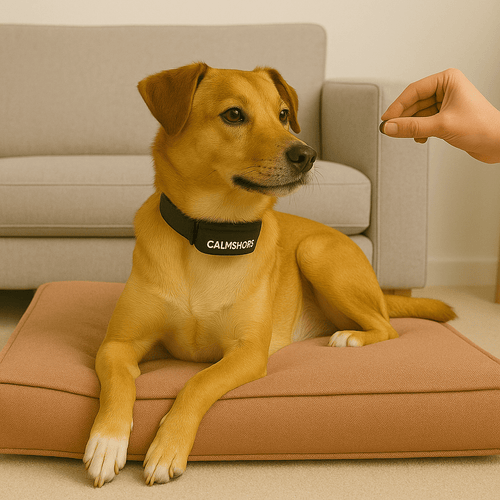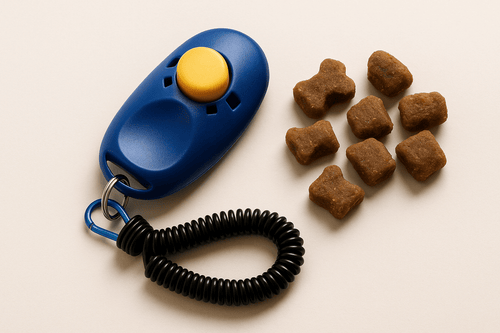

It is a fair question, and it deserves a straight answer rather than a sales pitch. Do calming chews really work?
The honest version is: for some dogs, partly, and only alongside other things. Some dogs settle noticeably. Some show a modest difference their owner only spots looking back. Some show nothing at all. No calming chew is a switch, and any company telling you otherwise is selling you something it cannot deliver.
That is not a very exciting answer, so the rest of this piece is about the useful part — what the ingredients are actually doing, which dogs tend to get something out of a chew, which dogs need more than one, and what to expect if you try.
What calming chews are

In the UK, a calming chew is a complementary feed. It is food, not medicine. It is not a sedative, it does not require a prescription, and it cannot treat, cure or prevent an anxiety disorder. What it can reasonably do is support a calmer state as one part of a routine that also includes training, management and a bit of forward planning.
Getting that framing right matters, because most disappointment with calming chews comes from expecting them to do a job they were never capable of doing.
What is usually in them

- Chamomile – a long-standing traditional botanical for supporting relaxation.
- Valerian root – traditionally used to support calm, usually paired with other botanicals rather than used alone.
- L-theanine – an amino acid found in tea leaves. One of the more studied ingredients in this category, and associated with relaxation without sedation.
- L-tryptophan – an amino acid and a precursor to serotonin.
- Passionflower – another traditional calming botanical, generally used as part of a blend.
- Ashwagandha, ginger and magnesium – supporting ingredients: an adaptogen, a digestive settler and a mineral involved in normal nerve and muscle function.
The evidence base varies considerably from one of these to the next. L-theanine has more behind it than most; several of the botanicals rest largely on long traditional use. That is a real distinction and it is worth knowing which you are buying.
So — do they work?

Here is the honest breakdown, by the kind of situation you are in.
Where a chew has the best chance
Mild to moderate, situational unsettledness with a predictable trigger. A car journey you know is coming. Fireworks night. A grooming appointment. The common thread is that you can feed ahead of the event and stack the chew on top of other preparation — a familiar blanket, a quiet room, some background sound.
Where a chew is unlikely to be enough
Genuine separation-related distress, panic, self-injury, or a dog who cannot settle at all. These are behavioural and veterinary problems. A complementary feed is not the answer to them, and reaching for one instead of getting help usually just delays the thing that would actually work.
Where it is genuinely hard to say
General, low-level restlessness with no obvious trigger. Some owners find a daily chew takes the edge off. Others find nothing changes. This is the group where trying it for a few weeks and watching honestly is the only way to know.
The other thing worth naming: it is very difficult to tell a modest real effect apart from the effect of everything else you changed at the same time. If you started a chew, moved your dog’s bed and began crate practice in the same week, you will not know which one did it. That is not a reason to avoid chews — it is a reason to be honest with yourself about what you are observing.
What makes a difference to whether it works

- Timing. Feed ahead of the trigger, not in the middle of it. Once a dog is already pacing and panting, you are behind the event.
- Giving it a fair run. One chew on the worst night of the year tells you almost nothing. For ongoing use, several weeks is a more sensible window than several days.
- What else you are doing. Reward-based training, gradual desensitisation and a predictable routine are doing the structural work. The chew supports it. Dogs whose owners change only the chew tend to be the ones who report nothing happened.
- The product itself. Named actives with quantities, dosing banded by body weight, and a company describing the product honestly. Our guide to reading a calming chew label covers what to look for, and our comparison of the main approaches covers how the different types differ.
- The dog. Individual dogs respond differently, and there is currently no way to predict in advance which group yours will be in.
Our chew, and what we will and won’t claim for it
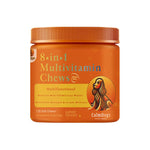
Calmdogs® Dog Calming Treats are a complementary feed in a 2.5 g turkey-flavoured soft chew, £14.95. Active ingredients per chew:
- Organic Chamomile – 60 mg
- Proprietary Relaxation Blend (Valerian Root, L-Tryptophan) – 55 mg
- Glucosamine HCl – 35 mg
- Organic Passionflower – 32 mg
- L-Theanine (Suntheanine®) – 21 mg
- Organic Ginger Root – 21 mg
- Ashwagandha – 18 mg
- Magnesium Citrate – 10 mg
Worth being straight about one thing: the valerian root and L-tryptophan are given as a combined 55 mg rather than split out individually, because they are supplied as a single proprietary blend. Every other active above is quantified on its own. We would rather say that than let you assume otherwise, particularly since we spend a good deal of our own advice telling people to check for exactly this.

What we will say: it is a turkey-based chew, which suits a lot of chicken-sensitive dogs; feeding is banded by body weight and printed on the pack; the ginger is there for digestive settling, which is why it tends to suit car journeys; and it is not sedating.
What we won’t say: that it works for every dog. That it is proven. That a vet has endorsed it. That it will fix separation anxiety. None of those would be true, and the version of this article we replaced said several of them.
Calmdogs® Dog Calming Treats are a complementary feed, not a veterinary medicine. They are not intended to treat, cure or prevent any condition. Individual dogs respond differently. If your dog shows ongoing signs of distress, speak to your vet or a qualified behaviour professional.
If you want to try one, do it properly
- Pick one trigger to work on rather than everything at once, so you can actually tell whether anything changed.
- Start at the feeding guide for your dog’s weight and stay there before adjusting.
- Feed ahead of the event, not during it.
- Keep a rough note. Memory is generous about things we have spent money on. A few lines after each occasion is more reliable than an impression.
- Pair it with training. Settling on a mat, calm greetings, gradual exposure. This is the part that compounds.
- Check with your vet first if your dog is pregnant, unwell or on medication.
Last bark
Do calming chews really work? For a decent number of dogs with mild, situational stress, fed at the right moment and combined with sensible training, they can be a useful part of the picture. For dogs in real distress, they are not the answer, and treating them as one costs time that dog does not have to spare.
If that sounds like a reasonable fit for your dog, Calmdogs® Dog Calming Treats are here. And if what you have read suggests your dog needs more than a chew, that is a more useful thing to have learned than a sale.
Frequently Asked Questions
Here are some common questions customers may have about this topic.
Do calming dog chews actually work?
Responses vary a great deal between individual dogs. Many owners find a calming complementary feed helps with mild, situational stress when it is fed ahead of a predictable trigger and combined with training and environmental changes. Others notice no difference. A calming chew is food rather than medicine, and it is not a treatment for a diagnosed anxiety problem.
Which ingredients are usually in a calming dog chew?
Common ingredients include chamomile, valerian root, passionflower, L-tryptophan, L-theanine, ashwagandha, ginger root and magnesium. L-theanine is among the more studied of these, while several of the botanicals rest largely on long traditional use. Look for a label that gives a quantity for each active rather than naming an unquantified blend.
What should I realistically expect after giving my dog a calming chew?
Expect a possible easing rather than a transformation, and expect it to depend on the dog. It also helps to change one thing at a time, because a modest effect is very hard to separate from everything else you may have adjusted in the same week. Feeding ahead of a known trigger, rather than once your dog is already unsettled, gives a fairer test.
Can calming chews be given every day?
Calming chews are complementary feeds and are generally well tolerated when fed according to the guide on the pack, which should be banded by your dog's body weight. Follow that guidance rather than increasing the amount, and speak to your vet before feeding any supplement to a dog that is pregnant, unwell or already on medication.
When is a calming chew the wrong tool?
If your dog panics, injures itself, destroys things when left alone, or cannot settle at all, that is a behavioural and veterinary question rather than a shopping one. Speak to your vet or a qualified behaviour professional, who can rule out pain or illness and build a plan for your dog. A complementary feed is not a substitute for that advice, and relying on one can delay the help that would actually work.