Skip to content


There is no dog pregnancy test you can do the way a human one works. Every reliable test on the market measures relaxin, a hormone produced by the developing placentas, and measuring it means taking blood. That single fact decides most of what follows.
The other thing worth knowing before you start is that timing beats technique. Test her too early and a negative tells you nothing at all, because there is not yet a placenta to detect. Below is what each method looks for, and the earliest day it can honestly give you an answer.
The four ways to find out, and when each one works
The day numbers here come from the MSD Veterinary Manual, and they are counted from mating rather than from the day you started wondering.
Relaxin blood test, from around day 22 to 27
Relaxin is produced once placentas are established, so a positive is a genuinely useful signal. MSD describes the commercial assay as specific and sensitive for detecting the presence of placentas after 22 to 27 days of gestation. Earlier than that, there is simply not enough to find.
This is the test the at-home kits are, and it is why they need a blood sample rather than a urine sample.
Abdominal palpation, from around day 21
An experienced vet can feel the individual swellings from about three weeks, and they roughly double in diameter each week after that. The catch is that the window closes: MSD notes that after day 35 to 38 the swellings become less distinct and palpation becomes difficult until late pregnancy. So if you are past five weeks and hoping someone can simply feel for puppies, that is often the hardest point to do it.
Ultrasound, best between day 25 and 35

Ultrasound is the one that tells you the most for the least discomfort. MSD puts the best window at 25 to 35 days and warns that before 21 days false-negative results may occur. It also shows whether the pregnancy is viable, which a hormone test cannot do.
What it is not good at is counting. Puppies move, overlap and hide behind each other, and a scan number is an estimate rather than a headcount.
X-ray, from around day 45, and after day 55 for counting
The puppies' skeletons start to calcify around day 28 but, as MSD puts it, are not detectable by routine radiography until approximately day 42 to 45, becoming prominent by day 47 to 48. Late-gestation radiography beyond 55 days is described as the best method for determining litter size.
That matters more than it sounds. Knowing she is carrying seven rather than two is what tells you whether whelping has finished, and it is the single most useful piece of information you can have at 3am.
About the home kits, honestly
We do not sell dog pregnancy tests and we are not going to send you to a marketplace to buy one, so take this as it is meant.
Home relaxin kits are real, and the better ones work. But they are blood tests. Some ask you to draw a drop from the gum, which is more than many owners are comfortable doing to a dog who has not agreed to it, and a poorly taken sample is the most common reason for a result you cannot trust. Before you buy one, it is worth pricing a vet appointment in the same week. For a similar outlay you get the sample taken properly, a scan that can also tell you the pregnancy is viable, and someone who can answer the questions that come next.
If you are breeding regularly, a kit earns its place. If this is a one-off, or an unplanned litter you are still absorbing, the vet is usually the better value as well as the safer route. Either way, your vet confirms it in the end.
A negative result is not always a no
Three things produce a negative in a dog who is in fact pregnant:
- You tested too early. Before roughly three weeks there is nothing for the test to detect. This is far and away the most common reason.
- The sample was poor. Too little blood, or handled badly.
- You are counting from the wrong day. Mating and conception are not the same date, and a dog mated over several days may be a week off where you think she is.
If she is behaving as though she is pregnant and the test says otherwise, retest a week later or book a scan rather than concluding it is settled. It is also worth knowing that a false pregnancy can produce many of the same outward signs, which is exactly why guessing from behaviour does not work.
She's pregnant. What now?
Three things, roughly in order.
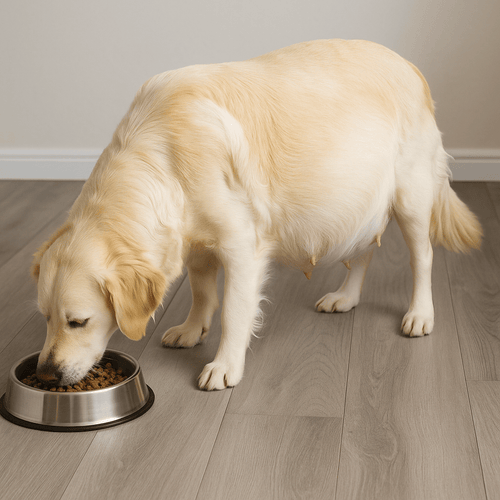
Get the dates straight. A confirmed pregnancy gives you an approximate due date, and it is worth understanding how long the pregnancy runs from here before you plan anything around it. From there, what happens in each of the nine weeks is more useful than watching her for changes that are not due yet.
Change the food gradually, not dramatically. Her calorie needs do rise, but not in week one, and putting weight on early helps nobody. Your vet will usually move her onto a higher-energy or growth formulation rather than adding anything to what she eats now.
Set up the whelping area sooner than feels necessary. Quiet, warm, easily cleaned, and somewhere she has time to accept as hers.
Where a supplement fits, and where it does not
A positive test is not by itself a reason to start buying things. A bitch on a complete, good-quality diet is frequently already covered, so treat a supplement as a conversation with your vet rather than a default next step, and it is worth reading properly on whether she needs a prenatal supplement at all before you order one.
Two cautions that matter more here than anywhere else. Do not add standalone calcium during pregnancy: it is not indicated and can make post-whelping hypocalcaemia more likely rather than less. And do not stack two products that contain the same nutrients, vitamin A above all. One product at the stated amount, agreed with your vet, is worth more than three chosen independently.
Ours is Calmdogs® Prenatal Chews, a complementary feed for breeding bitches with iron, zinc and folic acid. It contains vitamin A, which is precisely why it should not be given alongside another multivitamin without asking your vet first.
Calmdogs® Prenatal Chews are a complementary feed, not a veterinary medicine. They do not diagnose, treat, cure or prevent any disease or condition, and they are not a pregnancy test. Supplements complement a vet-approved diet rather than replacing it.
Last bark
There is no stick to wee on. What there is: a blood test that works from about three weeks, a scan that works best between four and five weeks and tells you more than the blood test does, and an X-ray after eight weeks that tells you how many are coming.
If you take one thing from this page, take the counting. Knowing the number before labour starts is the difference between a calm night and a frightening one.
Frequently Asked Questions
Here are some common questions customers may have about this topic.
How early can you tell if a dog is pregnant?
A relaxin blood test can detect the presence of placentas from about 22 to 27 days after mating. A vet may be able to feel the swellings by hand from around day 21, although that becomes difficult again after day 35 to 38. Ultrasound works best between day 25 and day 35. Before three weeks there is nothing reliable to find, so a negative result that early tells you very little.
Is there a dog pregnancy test you can do at home without a vet?
Home kits exist, but they are blood tests rather than urine tests, because they measure the hormone relaxin. Some require a drop of blood taken from the gum. They can work, but a poorly taken sample is the most common reason for a result you cannot rely on, and a vet visit in the same week often costs little more while also giving you a scan and a viability check.
Can a scan tell me how many puppies she is having?
Not reliably. Puppies move and overlap during a scan, so any number from an ultrasound is an estimate. X-ray after day 55 is described as the best method for determining litter size, because the skeletons are clearly visible by then. Knowing the number before labour begins is what tells you whether whelping has finished.
My dog tested negative but I still think she is pregnant. What should I do?
Testing too early is the most common explanation, followed by a poor sample and by counting from the wrong date, since mating and conception are not the same day. Retest about a week later, or book a scan, rather than treating one negative as settled. A false pregnancy can also produce similar outward signs, which is why behaviour alone is not enough to go on.
Does she need a supplement once the test is positive?
Not automatically. A bitch on a complete, good-quality diet is frequently already covered, and many vets will simply move her onto a higher-energy or growth formulation. If a supplement is used, decide with your vet, avoid stacking two products containing the same nutrients, and do not add standalone calcium during pregnancy, which is not indicated and can make post-whelping hypocalcaemia more likely rather than less.