Pregnancy gets all the attention, but lactation is the harder six to eight weeks on her body. The week she is producing milk for a whole litter is when her nutritional demand is at its highest point in the entire reproductive cycle, higher than at any stage of pregnancy itself. Most owners brace for the birth and are underprepared for what comes after it.
As with every page in this series: your vet leads this, not a blog. This page is general information for the six to eight weeks after whelping, from her side, not a substitute for a vet who can examine her and her puppies. If something here does not match what your vet has told you about your dog specifically, follow your vet.
If you are still working out how long a dog's pregnancy actually lasts, or you are further along and want the week-by-week pregnancy guide, both are worth reading first. If the pregnancy has not been confirmed yet and you are going on suspicion, confirming the pregnancy in the first place is the better starting point. This page picks up on the day the puppies arrive.
How much more she needs, and when it peaks
Her energy requirement does not rise in a straight line after whelping. It climbs, peaks hard in the middle of the nursing period, and then comes back down as the puppies start eating solid food themselves. Purdue University's Center for Canine Welfare gives a rough week-by-week shape to that curve: around twice her normal maintenance intake in weeks one and two, rising to around three times maintenance in weeks three and four as milk production peaks, then easing back to around twice maintenance in weeks five and six as the puppies begin weaning.
Three times her normal food intake is a lot to take in, and it is also only an average. The same source is explicit that it scales with how many mouths she is feeding: a practical starting point is to add roughly a quarter more food, on top of her maintenance amount, for every puppy in the litter, at peak lactation. A bitch nursing two puppies and a bitch nursing eight are not the same feeding problem, even though the timing curve looks the same for both.
What this means in practice is that "feed her a bit more" is not really enough guidance for this period. If she looks thin, is constantly hunting for food, or her milk supply seems to be dropping, the answer is very often simply more food, offered more often, rather than anything more complicated.
What to feed during nursing
The general approach recommended by FEDIAF's nutritional guidelines for reproduction and growth life stages is a complete food formulated for growth or "all life stages", rather than a standard adult maintenance diet, because it is calorie-dense and carries the higher protein and mineral levels lactation calls for. Many owners already have this in the house, since it is the same type of food the puppies themselves will move onto.
As a concrete benchmark, Purdue's Center for Canine Welfare gives a minimum of 17% fat and 29% protein on a dry matter basis for a lactating diet, well above what a standard adult maintenance food provides. The same source flags a specific trap: large-breed puppy food does not provide adequate nutrition during pregnancy or lactation, even though it is often the obvious reach for an owner of a large-breed dog. The growth or all-life-stages formulation this section is describing is not the same thing as a large-breed-specific puppy food.
Free access and constant water
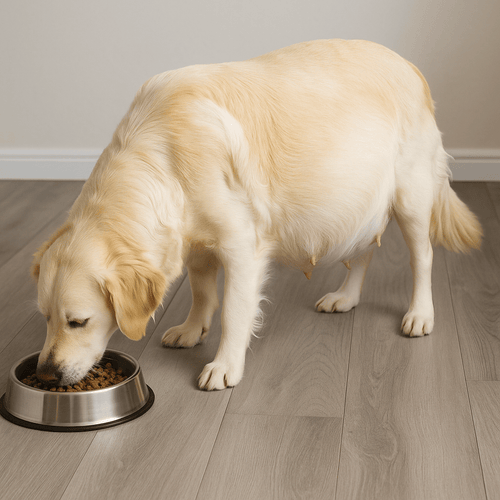
Rather than her usual one or two meals, most nursing bitches do better with food available more or less all the time during the peak weeks, plus constant access to fresh water. Milk is mostly water, and a nursing bitch drinks considerably more than usual. Some will not want to leave the puppies to eat or drink, so bringing food and water to where she is nesting, at least for the first couple of weeks, is common and sensible rather than something to worry about.
Gradual transitions and small, frequent meals
If she is moving from a pregnancy or maintenance food onto a growth formulation, change it over several days rather than swapping overnight, the same way you would for any diet change. As her appetite increases through the peak weeks, splitting her daily total into three or four smaller meals, rather than one or two large ones, tends to suit her better and reduces the digestive upset that can come from a nursing bitch eating a very large volume in one sitting.
Eclampsia: the reason this page exists
This is the section worth reading even if you skip everything else, because it is the one where waiting to look something up can cost you your dog.
Eclampsia, also called puerperal hypocalcaemia or periparturient hypocalcaemia, is a sudden, dangerous drop in blood calcium. According to the MSD Veterinary Manual, it typically appears two to three weeks after whelping, which lines up exactly with the point where her lactation demand is at its highest. It can technically happen in any breed with any size litter, but the classic picture is a small-breed bitch nursing a large litter, where the calcium draw from milk production simply outpaces what her body can mobilise and replace fast enough.
Signs start subtly and escalate quickly: restlessness and panting, then muscle tremors, stiffness and an unsteady gait, sometimes with disorientation or uncharacteristic aggression. Left untreated it can progress to seizures, coma and death. There is no home management for this. It is a same-day emergency, and if your vet is closed, it is an out-of-hours or emergency vet visit, not a wait-and-see.
The counterintuitive part, and the reason this cluster keeps repeating it, is what does not help: giving extra oral calcium during pregnancy itself. The MSD Veterinary Manual states plainly that oral calcium supplementation during gestation "is not indicated and may cause rather than prevent" this condition. Loading her system with calcium before whelping switches off the hormonal mechanisms she needs, during lactation, to pull calcium out of her own bone reserves on demand. The instinct to "top her up in advance" works against her, not for her.
Other reasons to call your vet in this window
Eclampsia is the headline risk, but it is not the only one. Ring your vet, rather than waiting to see, for any of the following in the six to eight weeks after whelping:
- Mastitis. A hot, hard, swollen or painful mammary gland, especially with the bitch reluctant to let puppies nurse from it, needs veterinary attention rather than home treatment.
- Retained placenta or metritis. A discharge that is heavy, foul-smelling or discoloured beyond the first day or two after whelping, or a bitch who seems unwell, feverish or off her puppies, can point to infection or retained tissue.
- A bitch who will not eat. A short dip in appetite in the first day or two after whelping is common on its own and not usually a concern. Reduced appetite that carries on beyond that, or any drop in appetite once she reaches peak lactation in weeks three and four, when her needs are at their highest, is not something to wait out.
- Puppies not gaining weight. If you are weighing the litter daily, as most breeders do, and one or more puppies are static or losing weight rather than steadily gaining, that is a call to make regardless of how the bitch herself looks.
Where a supplement fits, honestly

Her food does the heavy lifting through this period. Nothing in this section changes that, and nothing sold as a chew replaces a correctly formulated, sufficiently generous diet during lactation. If you have not yet decided whether a supplement is worth adding at all, choosing a prenatal supplement covers the criteria worth checking on any label, ours included.
Our own Calmdogs® Prenatal Chews are labelled for use from mating, through pregnancy, and through the nursing period. If you have already been using them through pregnancy, the pack supports carrying on. Three of the actives carry a stated amount per chew: iron 2.5 mg, zinc 1 mg and folic acid 30 mcg. The rest of the blend on the label, including vitamins E, A, D3 and B12, niacin, thiamine, pyridoxine, biotin, pantothenate, magnesium, manganese, selenium, ferrous fumarate, fish oil, nettle leaf and MSM, is listed without a stated amount, the same way we describe it on the product page itself.
Read plainly, that is a small daily amount of a few specific nutrients, alongside a longer list of ingredients present in an unstated quantity. It is not a calcium supplement, it contains no stated calcium at all, and nothing about it is a response to the eclampsia risk covered above, which is a whole-diet and whole-body issue, not a gap one chew closes. It does not increase milk supply or milk quality, and it is not a way to avoid feeding enough of a proper growth-formulated diet during the peak weeks. What it is, honestly, is a small complementary feed some owners choose to continue through nursing, on their vet's advice, alongside a diet that is already doing the actual work.
If that reads as a modest claim for a product we sell, that is deliberate. Every other page in this series tells you to be sceptical of exactly the claims we are not making here, and making them now would undo that.
Calmdogs® Prenatal Chews are a complementary feed, not a veterinary medicine. They do not diagnose, treat, cure or prevent any disease or condition. Give them alongside a complete, balanced diet and on your vet's advice, and never alongside other supplements containing the same nutrients without checking first.
Weaning: her intake comes back down
As the puppies move onto solid food, starting around four weeks old, they take a steadily larger share of their nutrition from a bowl rather than from her, and her own production, and therefore her requirement, tapers off. By the time they are fully weaned her intake should be back towards a normal maintenance amount rather than the elevated level she needed at peak.
That taper should follow the puppies, not a fixed date on a calendar. Bringing her food back down too quickly, before the litter has genuinely reduced how much they are nursing, risks leaving her underfed while demand is still real. Bringing it down too slowly once they are properly weaned puts weight and condition on her that then has to come back off. Watching the puppies rather than the calendar is the more reliable guide either way.
Last bark
Lactation, not pregnancy, is where her body is working hardest, and it peaks around two to three weeks after whelping, exactly when eclampsia risk is highest too. Feed her considerably more than usual, offered more often, on a proper growth-formulated diet, watch her and the litter closely through that window, and keep your vet's number somewhere you can find it at short notice.
A chew has a small, honest place in that picture. The diet, the watching, and the vet carry the large one.
Frequently Asked Questions
Here are some common questions customers may have about this topic.
How much more food does a nursing dog need?
Roughly twice her normal maintenance intake in the first two weeks after whelping, rising to around three times maintenance in weeks three and four as milk production peaks, then easing back towards twice maintenance in weeks five and six. It scales with litter size, so a good starting point is to add around a quarter more food, on top of maintenance, for each puppy she is nursing.
What is eclampsia and how do I know if my dog has it?
Eclampsia is a sudden, dangerous drop in blood calcium, usually appearing two to three weeks after whelping, most classically in small-breed bitches nursing large litters. Early signs are restlessness and panting, progressing to muscle tremors, an unsteady gait and disorientation, and it can advance to seizures if untreated. It is a same-day emergency, not a wait-and-see situation.
Should I give my dog extra calcium to prevent eclampsia?
No. Oral calcium supplementation during pregnancy is not recommended and may increase the risk of eclampsia rather than reduce it, because it suppresses the hormonal system she relies on to mobilise her own calcium once she is nursing. Any calcium supplementation should only be given on your vet's specific advice, not as routine prevention.
What should I feed a nursing dog?
A complete diet formulated for growth or all life stages, rather than a standard adult maintenance food, since it carries the calorie density and protein levels lactation demands. Offer food more or less freely during the peak weeks, keep water constantly available, and split her daily amount into three or four smaller meals rather than one or two large ones.
When should I call the vet during the nursing period?
Call promptly for any sign of eclampsia, a hot or painful mammary gland, a heavy or foul-smelling discharge beyond the first day or two, reduced appetite that carries on past the first day or two or drops at peak lactation in weeks three and four, or puppies that are not gaining weight when you weigh the litter.