Skip to content


Are shock collars legal in the UK? Electric shock collars are banned in Wales and nowhere else in the UK. England drafted a ban but never made it law, Scotland voted down a ban amendment, and Northern Ireland has no specific law. Below is what the law says in each nation, with every source linked. Checked 16 November 2026.
First, where we stand. We're a small family-run shop in Oxfordshire and we sell vibration collars and citronella spray collars. We do not sell shock or static collars, and we don't recommend them. That's our view, not a legal claim, and we've kept the two apart on this page.
Are shock collars legal in the UK? The four nations at a glance
| Nation | Shock collar ban? | What applies |
|---|---|---|
| Wales | Yes, since March 2010 | Animal Welfare (Electronic Collars) (Wales) Regulations 2010 |
| England | No | Draft 2023 regulations were never made; general unnecessary-suffering offence |
| Scotland | No | Ban amendment defeated January 2025; advisory government guidance; general unnecessary-suffering offence |
| Northern Ireland | No | No specific legislation; general unnecessary-suffering offence |
Wales: what exactly is banned?
Wales is the only UK nation with a ban. The Animal Welfare (Electronic Collars) (Wales) Regulations 2010 came into force on 24 March 2010. Regulation 2(1) prohibits a person from doing any of these, and regulation 3 makes a breach an offence:
- attaching an electronic collar to a cat or a dog;
- causing an electronic collar to be attached to a cat or a dog;
- being responsible for a cat or a dog to which one is attached.
The regulations define an "electronic collar" as "a collar designed to administer an electric shock". Two things follow from that wording. The prohibitions are about fitting and using; the regulations say nothing about selling or owning one. And spray, vibration and tone collars sit outside the definition, because they aren't designed to give a shock.
Is there a shock collar ban in England?
No. There is no ban on shock collars in England. It's an easy one to get wrong, because a ban was planned and got partway through Parliament.
Here is the official parliamentary timeline for the draft Animal Welfare (Electronic Collars) (England) Regulations 2023:
- 27 April 2023: draft regulations laid before Parliament.
- 19 June 2023: approved by the House of Lords.
- 26 October 2023: the Commons approval motion lapsed at the end of the session.
- 7 November 2023: the motion was tabled again.
- 24 May 2024: it lapsed again at the end of that session.
The Commons never approved the draft, so the regulations were never made and no ban took effect. The draft had named 1 February 2024 as its start date. In a written answer (question tabled 31 January 2024, answered 15 February 2024), Defra minister Mark Spencer said: "Pressing ahead with the Regulations at the start of this year would have left an unacceptably short window for pet owners to adapt their training methods." He added that "The Government remains committed to introducing a ban on the use of e-collars." As of the date at the top of this page, no ban is in force in England.
Owning or using a shock collar is not in itself illegal in England. Causing an animal unnecessary suffering is, under section 4 of the Animal Welfare Act 2006, whatever device is involved. That section applies in Wales too.
Did Scotland ban shock collars?
No. A ban was put to a vote and lost.
At Stage 3 of the Welfare of Dogs (Scotland) Bill on 23 January 2025, MSP Ross Greer moved amendment 18. It would have added to the matters covered by the new code of practice "whether the acquirer is committed to preventing unnecessary suffering and ensuring the welfare of the dog (for example, by not using any device which applies an electric current to the dog's skin)". MSPs rejected it by 84 votes to 28. The Bill passed the same day and became the Welfare of Dogs (Scotland) Act 2025 on 19 March 2025. That Act sets up a code of practice on acquiring a dog. It doesn't mention collars or any specific training device.
Scottish Government guidance on dog training aids says it does not condone electronic shock (static pulse) collars, and points out that causing unnecessary suffering is an offence under section 19 of the Animal Health and Welfare (Scotland) Act 2006. The guidance says it is advisory, though a court may consider it in a prosecution. To be straight with you, the same guidance also lists electronic anti-bark collars and devices that squirt citronella among the things it does not condone.
Are shock collars legal in Northern Ireland?
Yes. There is no ban on shock collars in Northern Ireland, and no law aimed specifically at them.
In the Northern Ireland Assembly on 17 June 2024, Dr Steve Aiken asked Agriculture Minister Andrew Muir whether he planned to ban electric and prong collars. The minister replied that "the use of shock collars or e-collars is not banned in Northern Ireland" and that "a person may use an e-collar on an animal only if it does not cause unnecessary suffering". Misuse could make someone liable for prosecution under the Welfare of Animals Act (Northern Ireland) 2011. He said he was keen to explore how a ban could be achieved, but set no date. That was an answer to a question in the chamber, not a vote.
One common mix-up: search results about Northern Ireland often pick up news from the Republic of Ireland. The Republic is a separate state with its own laws, and this page covers the UK only.
What does this mean if you already own one?
In Wales, fitting one to your dog, or being responsible for a dog wearing one, is an offence. Outside Wales, owning or using one is not in itself against the law. In all four nations, though, causing a dog unnecessary suffering is an offence, whatever device was used.
None of this is advice on whether to use one. It's the legal position only. Our own view is at the top of the page, and it doesn't change at the border.
What about vibration and spray collars?
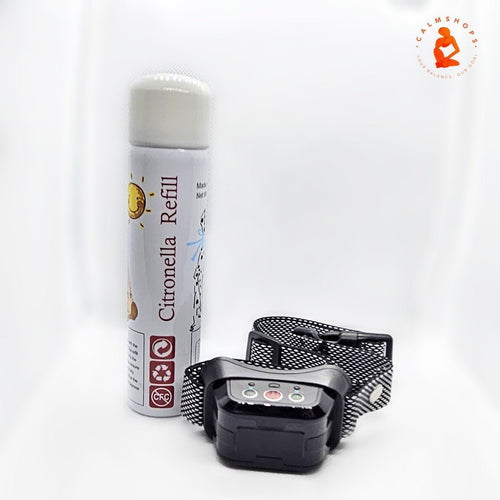
No UK nation bans vibration or citronella spray collars, and neither type is designed to give a shock. They're what we stock: vibration collars and citronella spray collars. Most of our remote spray collars also have tone and vibration modes, so one collar can cover more than one approach. Bear in mind the Scottish guidance above: legal is not the same as officially encouraged.
Whatever you choose, start with the gentlest setting and pair every cue with praise or a treat. A collar can help interrupt a behaviour; it's the reward that teaches the dog what to do instead. If your dog barks or panics when left alone, or is frightened of noises, please skip the collar altogether and speak to your vet or a qualified behaviourist.
The short version
One nation bans shock collars outright: Wales. England drafted a ban that was never made, Scotland rejected a ban amendment, and Northern Ireland hasn't legislated. This is the kind of law that moves, so check the linked sources again before you rely on it.
Frequently asked questions
Are shock collars illegal in the UK?
Only in Wales. Since March 2010 it has been an offence there to attach a collar designed to administer an electric shock to a cat or dog, or to be responsible for one wearing it. England, Scotland and Northern Ireland have no ban, although causing an animal unnecessary suffering is an offence in every UK nation, whatever device is used.
Why do so many websites say shock collars are banned in England?
Because a ban was planned and got partway through Parliament. Draft regulations were laid in April 2023 and approved by the House of Lords in June 2023, but the Commons approval motion lapsed twice, in October 2023 and May 2024. The regulations were never made, so there is no ban in England. Older articles often report the plan rather than the outcome.
Did Scotland ban shock collars?
No. On 23 January 2025 MSPs voted 84 to 28 against amendment 18 to the Welfare of Dogs (Scotland) Bill, which would have brought devices applying an electric current to a dog's skin into the new code of practice. The Act that followed covers acquiring a dog, not training devices. Scottish Government guidance does not condone shock collars, but it is advisory, not a ban.
Is a shock collar legal in Northern Ireland?
Yes, there is no ban in Northern Ireland. In June 2024 the Agriculture Minister told the Assembly that e-collars are not banned but may be used only if they do not cause unnecessary suffering, and that misuse could lead to prosecution under the Welfare of Animals Act (Northern Ireland) 2011. The Republic of Ireland has its own separate laws.
Is it illegal to sell or own a shock collar in Wales?
The Welsh regulations say nothing about selling or owning one. They make it an offence to attach a collar designed to administer an electric shock to a cat or dog, to cause one to be attached, or to be responsible for a cat or dog wearing one. Spray, vibration and tone collars are outside that definition.
Does Calmshops sell shock collars?
No. We sell vibration collars and citronella spray collars, and we do not sell shock or static collars. None of these types is banned anywhere in the UK. Scottish Government guidance does not condone electronic anti-bark collars or citronella-spraying devices either, so if you use any collar, start on the gentlest setting and pair it with reward-based training.