Ir directamente al contenido


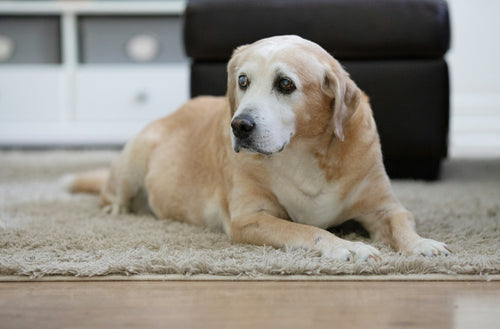
You have probably noticed it in small things rather than one big moment. A pause at the bottom of the stairs. A slower start on the first walk of the day. Choosing the rug instead of jumping onto the sofa.
Some slowing down is normal ageing, and some of it isn't — the difference usually shows in whether it is gradual and even on both sides, or sudden and one-sided. Gradual, symmetrical stiffness that eases once your dog gets going is common in older dogs. Anything sudden, anything limited to one leg, and anything painful is a different conversation.
Before anything else: if your dog is limping, yelping, holding a leg up, refusing to put weight on a leg, or went from fine to not-fine within a few days, book a vet appointment. Do not wait to see how it goes, and do not start a supplement instead. Cruciate ligament ruptures, hip dysplasia, injuries and a range of other problems all present as a dog who has "slowed down" right up until somebody examines them properly. Some of them are time-sensitive.
With that said — here is what to look for, and what actually helps.
What normal ageing looks like

Dogs age unevenly across breeds and sizes. How long dogs generally live has a lot to do with how big they are, and the same is true of when they start to slow — a great dane is old at seven, a jack russell may be barely middle-aged at ten. But the general pattern of ordinary ageing looks like this:
- A gradual reduction in stamina over months and seasons, not days.
- Stiffness after a long lie-down that eases within a few minutes of moving.
- More sleep, and deeper sleep.
- Less enthusiasm for the third hour of a walk, while the first hour is unchanged.
- Both sides equally affected.
That last point does a lot of work. Ageing is generally symmetrical. Injury and single-joint disease generally are not.
What is worth watching more closely

These are not emergencies, but they are worth writing down with a date, because a pattern over a fortnight is much more useful to a vet than "he's been a bit slow lately":
- Reluctance on stairs, particularly going down.
- Hesitating before jumping into the car or onto furniture, or taking a run-up where they never used to.
- Walks that get shorter because your dog turns for home, not because you do.
- Stiffness that is worse in cold weather or after a big day out.
- Licking or chewing at one joint repeatedly.
- A changed sleeping position, or restlessness settling at night.
- Sitting with a leg out to one side rather than tucked.
- A shortened stride, or a bunny-hopping gait behind.
Video is genuinely useful here. Thirty seconds of your dog walking towards and away from the camera on a hard floor tells a vet more than several paragraphs of description, and dogs have an infuriating habit of moving perfectly in the consulting room.
Slowing down versus lameness
Worth separating clearly, because owners often use the words interchangeably.
Slowing down is a change in willingness and stamina. Your dog can still do things, and does them a bit less.
Lameness is a change in how the leg is used — a head-nod as one front foot lands, a hip that drops, a leg carried. Lameness is a clinical sign. It has a cause, and finding the cause is a job for someone with their hands on the dog and, often, a radiograph.
The single most useful thing you can do

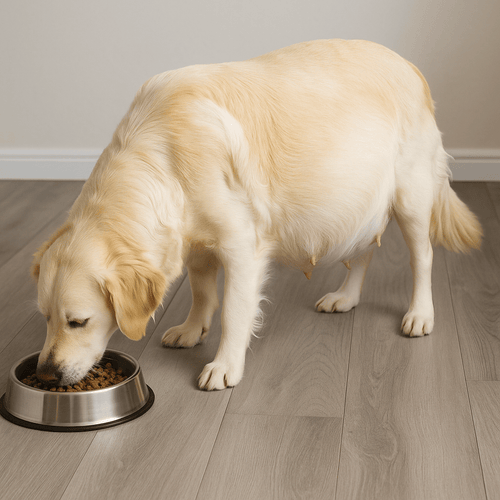
Keep your dog lean. It is free, it is the best-evidenced intervention in this whole subject, and it is the thing most often skipped past on the way to buying something. So the first question worth answering honestly is whether your dog is carrying extra weight.
A study followed 48 Labradors in pairs across their whole lives, one of each pair fed 25% fewer calories than the other. The restricted dogs reached a median age of 12 years before radiographic hip osteoarthritis was first identified. Their normally fed littermates reached that point at 6. By the age of 14, half the lean dogs showed changes against 83% of the controls (Smith et al., JAVMA, 2006, 229(5):690–699).
Six years of joint health, from feeding less.
And if your dog is already carrying weight and already stiff, it is not too late and the target is smaller than you think. In obese dogs with osteoarthritis, measurable improvement in lameness appeared from around 6.1% of body weight lost (Marshall et al., Veterinary Research Communications, 2010, 34(3):241–253). On a 30 kg dog that is under 2 kg. On a 12 kg spaniel it is about 700 g.
Most of us are worse at judging our own dog's condition than we think, incidentally — you should be able to feel ribs under a thin layer without pressing, and see a waist from above. Your vet nurse will body-condition score a dog for free and will be kind about it.
The other things that help

Consistent, moderate exercise rather than nothing all week and five miles on Sunday. Regular movement maintains the muscle that supports the joints; the weekend-warrior pattern is the one that produces Monday-morning stiffness.
Traction indoors. Laminate and tile are genuinely difficult for an older dog, and a few runners along the routes they use most — bed to door, sofa to kitchen — take out a surprising amount of daily effort and slipping.
Ramps instead of jumps, particularly in and out of the car, which is often the single hardest movement in a dog's day.
A warm, supportive bed, away from draughts. Cold floors and thin bedding make morning stiffness worse.
Your vet's plan, if there is a diagnosis. If it turns out to be arthritis, that is a veterinary condition needing veterinary management — pain relief, a weight plan, exercise modification, monitoring. That plan is the treatment. Everything else, including anything sold in a tub, sits alongside it.
Somewhere near the bottom of that list, a joint supplement can be part of the routine. We make one — Calmdogs® Active Hip & Joint Chews, a complementary feed with glucosamine, chondroitin and MSM — and we would rather you read our honest write-up of what glucosamine, chondroitin and MSM actually do, and how strong the evidence really is, before you decide it is worth your money. It is not the answer to this post. Weight is.
When to call the vet, plainly
Today, if: your dog is not putting weight on a leg, is yelping or crying out, has a hot or swollen joint, went suddenly lame, or has collapsed or become unable to rise.
Within a week or so, if: there is a persistent limp, one-sided stiffness, stiffness that is not improving after a few minutes of movement, a change in appetite or temperament alongside the slowing down, or you are simply not sure.
At the next routine appointment, if: the change is gradual, even on both sides, and your dog is otherwise themselves. Mention it anyway. Early is better, and "he's just getting old" is a conclusion, not an observation.
One practical note. If you have moved recently, or you are between practices, finding a vet near you is worth doing now rather than at half past ten on the night something goes wrong. Registering takes ten minutes when it is not urgent.
Last bark
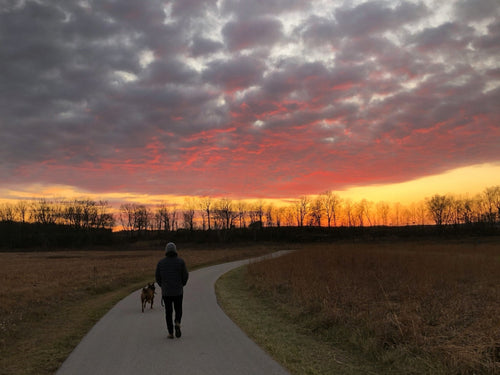
Figo is a cocker spaniel and we walk him around Oxfordshire in most weathers, which means we see the same dog on the same paths in wildly different conditions. It is remarkable how much a wet, cold February morning changes what a dog looks like on the way home — and how easy it would be to read that as something more.
Which is the honest summary, really. You know your dog better than anyone, and you are also the least well-placed person to notice a slow change, because you see them every single day. Write things down. Take the video. Keep them lean. And get anything sudden, one-sided or painful looked at by someone qualified, rather than by a search engine.
Frequently Asked Questions
Here are some common questions customers may have about this topic.
Why is my dog slowing down?
Some slowing down is ordinary ageing: a gradual loss of stamina across months, more sleep, and stiffness after resting that eases within a few minutes of moving, affecting both sides evenly. Slowing down that is sudden, one-sided, painful, or not improving with movement is different and should be assessed by a vet, because injuries and joint disease often look like a dog simply getting older.
What are the early signs of joint problems in dogs?
Common early signs include reluctance on stairs, particularly going down, hesitating before jumping into the car, walks that shorten because the dog turns for home, stiffness that is worse in cold weather, repeated licking at one joint, a changed sleeping position, sitting with a leg out to one side, and a shortened or bunny-hopping stride. Noting the date each sign appears gives your vet far more to work with.
When should I take a stiff or slow dog to the vet?
Go the same day if your dog will not put weight on a leg, is yelping, has a hot or swollen joint, went suddenly lame, or cannot rise. Go within a week for a persistent limp, one-sided stiffness, stiffness that does not ease with movement, or any change in appetite or temperament alongside it. For gradual, even changes in an otherwise well dog, raise it at the next routine appointment rather than putting it off.
What helps a dog that is stiff and slowing down?
Keeping your dog lean has the strongest evidence of anything you can do, and it costs nothing. Beyond that: consistent moderate exercise rather than occasional long walks, non-slip runners on hard floors, a ramp instead of jumping into the car, and a warm supportive bed away from draughts. If there is a diagnosis such as arthritis, your vet's plan is the treatment and everything else sits alongside it.
How much weight does an overweight dog need to lose to move more comfortably?
Less than most owners expect. In a study of obese dogs with osteoarthritis, measurable improvement in lameness appeared from around 6.1 per cent of body weight lost, which on a 30 kilogram dog is under 2 kilograms. A separate lifelong study of Labradors found that dogs fed 25 per cent fewer calories reached a median age of 12 years before hip osteoarthritis was first seen on radiographs, against 6 years in their normally fed littermates.